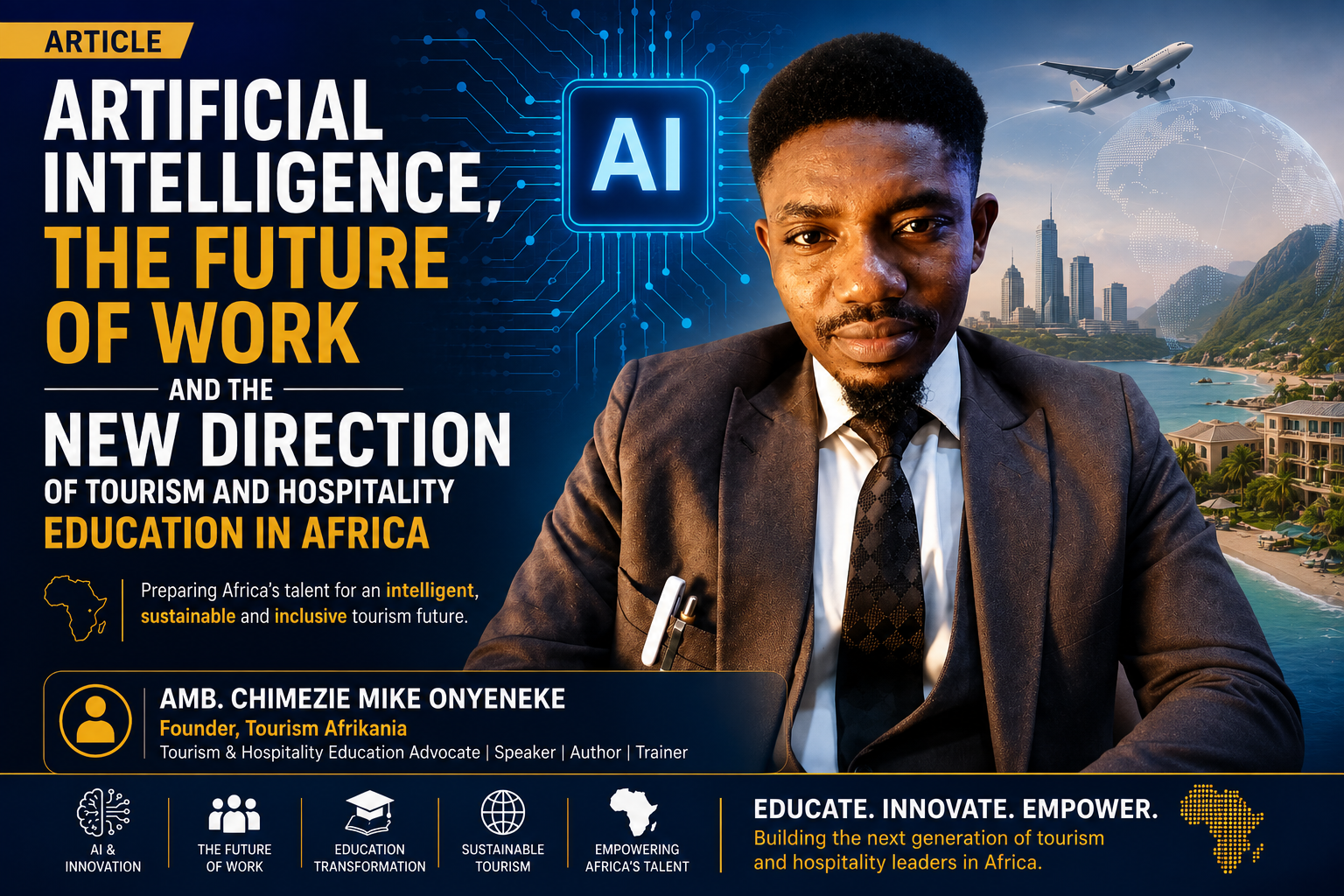
Artificial Intelligence, the Future of Work and the New Direction of Tourism and Hospitality Education in Africa
As the world prepares to celebrate World Tourism Day on September 27, 2026, the global tourism community is being invited to reflect on a subject that is already transforming how we live, work, learn and do business.
The proposed theme for World Tourism Day 2026 is “Digital Agenda and Artificial Intelligence to Redesign Tourism.” It is a timely call for governments, businesses, educators, professionals and young people to think seriously about the future of an industry that is increasingly being shaped by technology and intelligent systems.
Artificial Intelligence is no longer a distant idea reserved for technology companies and research laboratories. It has entered the workplace. It is influencing how businesses communicate with customers, analyse information, make decisions, market products and deliver services.
For the tourism and hospitality industry, the transformation is already noticeable.
AI Is Changing the Workplace and the Way Businesses Operate
Across different industries, Artificial Intelligence is helping organisations automate repetitive tasks, process large amounts of information, improve productivity and better understand customer behaviour.
However, the most important conversation should not simply be about whether AI will replace people.
The bigger question is: How can people learn to work intelligently with AI?
The workplace of the future will increasingly require professionals who can combine human intelligence, creativity, emotional intelligence, critical thinking and technology.
AI can process information quickly, but hospitality is still fundamentally about people.
A machine can recommend a hotel, but it cannot completely replace genuine human warmth.
A chatbot can answer questions at midnight, but it cannot fully reproduce empathy.
Technology can automate processes, but people remain central to relationships, culture, leadership and memorable service experiences.
Therefore, the future is not necessarily AI versus human beings.
The future is more likely to belong to human beings who understand how to use AI responsibly and effectively.
Noticeable Changes in Tourism and Hospitality
The tourism and hospitality industry is experiencing significant changes as businesses adopt digital tools and Artificial Intelligence.
Today, AI can support businesses in areas such as:
- Customer service through intelligent chatbots and virtual assistants.
- Personalised travel recommendations based on customer preferences.
- Digital marketing and content creation.
- Revenue management and pricing decisions.
- Demand forecasting and business planning.
- Hotel booking and customer relationship management.
- Data analysis and consumer behaviour insights.
- Destination marketing.
- Translation and multilingual communication.
- Operational planning and workflow improvement.
Hotels are increasingly able to use data to better understand guest preferences. Travel businesses can personalise offers. Tourism marketers can analyse audience behaviour and create more targeted campaigns.
AI is also helping travellers discover destinations, compare options, plan itineraries and access information more quickly.
The proposed World Tourism Day 2026 theme recognises this growing transformation and highlights how digitalisation and Artificial Intelligence can improve customer experiences, operational efficiency and sustainable tourism practices. (ga.untourism.int)
But technology alone is not the solution.
The real value comes from how intelligently, ethically and creatively we use it.
AI Is Creating New Opportunities for Tourism Businesses:
For African tourism and hospitality businesses, AI presents an important opportunity.
Many small and medium-sized enterprises may not have the financial capacity to employ large teams of researchers, marketers, data analysts and technology experts. AI tools can help entrepreneurs perform some of these functions more efficiently and competitively.
A small tour operator can improve its marketing.
A hotel can better understand customer feedback.
A restaurant can develop stronger digital engagement.
A destination management organisation can analyse visitor trends.
A tourism entrepreneur can research markets and identify new opportunities.
A student can explore ideas, develop concepts and learn new skills.
But there is an important warning: access to AI does not automatically mean competence in using AI.
Recent research in hospitality and tourism education suggests that simply being familiar with AI is not enough. Students and professionals also need the ability to evaluate AI-generated information, exercise judgement and understand responsibility and consequences. (ScienceDirect)2)
This is where education becomes critical.
What Are Schools and Institutions Doing?
Around the world, hospitality and tourism education is beginning to respond to the digital transformation of the industry.
Research into tourism and hospitality curricula has shown increasing attention to emerging technologies, digital competencies and new career opportunities connected to AI and technology. However, technology-focused courses and curriculum integration still require greater development in many programmes. (ScienceDirect(3))
The conversation is therefore moving beyond simply teaching students how to use software.
The future curriculum must prepare students to understand:
- Artificial Intelligence and its applications.
- Data and digital literacy.
- AI-supported marketing.
- Digital customer experience.
- Prompting and responsible use of generative AI.
- Revenue and business analytics.
- Virtual and augmented reality.
- Smart tourism technologies.
- Digital entrepreneurship.
- Cybersecurity and data privacy.
- Ethics and responsible decision-making.
Research published in 2026 also highlights the growing importance of AI literacy, data analysis, creativity, interdisciplinary knowledge, AI applications and awareness of ethical and legal issues in preparing future hospitality and tourism professionals. (Taylor & Francis Online)
For African institutions, this should be a serious call to action.
Education Must Build the Solutions We Want to See
As Africa prepares for a more digital future, we must ask ourselves an important question:
Are we educating students for yesterday’s industry or preparing them for tomorrow’s realities?
The purpose of education should not simply be to award certificates.
Education must build capacity.
Education must develop problem-solvers.
Education must encourage creativity.
Education must connect students with industry realities.
And education must prepare young Africans to become creators of solutions rather than only consumers of technology developed elsewhere.
African Hospitality and Tourism Education must therefore become more practical, innovative, entrepreneurial and technology-conscious.
Our classrooms should increasingly connect with hotels, airports, travel agencies, restaurants, destinations, technology companies and tourism entrepreneurs.
Students should not graduate without understanding the realities of the modern workplace.
They should be exposed to practical projects.
They should learn how to solve real industry problems.
They should understand how technology can support service excellence.
And they should develop the confidence to create businesses and opportunities.
AI should not become another subject that students memorise only to pass examinations.
It should become a tool for thinking, innovation, research, problem-solving and responsible business development.
Africa Must Not Be Left Behind
The AI revolution presents both opportunities and challenges.
There are concerns around infrastructure, access to technology, internet connectivity, faculty readiness, funding, data privacy and the digital divide.
These challenges are real.
But they should not become excuses for Africa to remain behind.
Instead, they should inspire stronger collaboration between governments, educational institutions, industry professionals and technology organisations.
African institutions need to begin asking:
What AI skills do our students need?
Are our lecturers prepared to teach emerging technologies?
Are our curricula responding to industry transformation?
How can industry participate in curriculum development?
How can students use AI without losing critical thinking and creativity?
How can Africa develop technology solutions that reflect African tourism realities?
These are conversations that can no longer be postponed.
The Human Side of Artificial Intelligence
As we embrace AI, we must also remember the unique nature of hospitality.
Hospitality is about welcoming people.
Tourism is about experiences.
Travel is about discovering cultures and connecting with places.
No matter how advanced technology becomes, the industry will continue to require human qualities such as empathy, communication, cultural understanding, leadership and emotional intelligence.
The future professional must therefore be both technologically competent and deeply human.
We must not produce graduates who can use technology but cannot communicate effectively.
We must not produce professionals who can generate AI content but cannot solve real problems.
We must not allow convenience to replace creativity.
The goal should be to use Artificial Intelligence to enhance human capacity not weaken it.
A Call to Action for African Hospitality and Tourism Education
As we approach World Tourism Day 2026, the conversation around Artificial Intelligence gives us an opportunity to reflect on the kind of tourism future we want to build.
The future of African tourism will not be built by technology alone.
It will be built by educated people who understand technology and know how to apply it to African realities.
This is why education must remain at the centre of our transformation agenda.
At the African Hospitality and Tourism Education Summit (AHTES), we continue to promote the importance of Hospitality and Tourism Education in Africa.
We believe that education is the foundation for service excellence, innovation, entrepreneurship and sustainable industry development.
As Artificial Intelligence continues to reshape workplaces and businesses, the responsibility of educational institutions becomes even greater.
We must rethink.
We must innovate.
We must collaborate.
We must modernise our learning systems.
And most importantly, we must prepare a new generation of African hospitality and tourism professionals who are ready not just to participate in the future but to help create it.
As we celebrate World Tourism Day on September 27, 2026, let us embrace the message behind “Digital Agenda and Artificial Intelligence to Redesign Tourism.”
Let us see Artificial Intelligence not simply as a technological trend, but as an opportunity to rethink how we educate, how we work, how we serve and how we build businesses.
The future of tourism is digital.
The future of hospitality is intelligent.
But the future of Africa's tourism and hospitality industry must be powered by something even more important:
Educated people with the knowledge, creativity and courage to build the solutions we want to see.
At AHTES, the conversation continues.
The future of African Hospitality and Tourism Education must be practical, innovative, inclusive and ready for the world that is emerging.